Siege of Namur (1695)
The Life and Opinions of Tristram Shandy, GentlemanThe Siege of Namur (1695) matters in The Life and Opinions of Tristram Shandy, Gentleman less as a continuous campaign history than as the battle remembered through Uncle Toby’s wound. The siege gives him a precise place of suffering, a story he struggles to make intelligible, and, eventually, a map on which he can recover the ground where a stone struck him. Military action thus returns not only as remembered combat but as the organizing pursuit that gives shape to his convalescence.
The Attack at Saint Nicholas Gate
The remembered action centers on an attack by English and Dutch forces against the point of the advanced counterscarp between Saint Nicholas Gate and the works protecting a great sluice, or water-stop. From the counter-guard and demi-bastion of Saint Roch, the English were exposed to enemy fire. The Dutch established themselves on the counter-guard, while the English took the covered way before the gate, despite the French officers’ resistance on the glacis, where they fought sword in hand.
This engagement was the principal attack at Namur that Uncle Toby witnessed. The confluence of the Maes and Sambre separated the besieging forces and prevented them from seeing much of one another’s operations; the limitation of the view helps explain why Toby’s account concentrates so intently on this one contested sector. The scene survives in his telling as a close study of connected defensive positions rather than as a broad account of the siege.
Toby’s Wound and the Return to England
The engagement becomes decisive in the novel through its bodily cost to Uncle Toby. A stone struck him in the groin during the siege, leaving him unfit for service and making his return to England necessary so that he might recover. The text locates the wound with unusual precision: Toby was in one of the traverses, about thirty toises from the returning angle of the trench opposite the salient angle of Saint Roch’s demi-bastion. A military position that might otherwise remain an abstract feature of the defenses becomes the exact ground of his injury.
The siege’s consequences continue long after the attack. Toby spent four years confined, some of them to bed and all of them to his room, suffering as fragments of the damaged pubic and iliac bones worked free. The surgeon judged that the stone’s weight, more than the force of its flight, had caused the injury, and called that distinction fortunate; the account’s clinical explanation sits uneasily beside the prolonged pain it describes. His wound is at once a consequence of the campaign and the condition that redirects his life toward recovery at home.
The Wound Becomes a Map
The injury also changes the way Uncle Toby can speak about the siege. Visitors came upstairs to his bedside, where he was encouraged to recount the attack, but the technical vocabulary resisted easy explanation: scarp and counterscarp, glacis and covered way, half-moon and ravelin. Even military writers, the narrator observes, confused these terms. Toby’s effort to distinguish them could therefore bewilder his listeners and sometimes Toby himself, turning recollection into a struggle to make a difficult landscape mentally visible.
The difficulty mattered because Toby’s account was not detached military instruction. His wound fixed him in a position from which he could not readily retreat, and the small frustrations of explaining the works were imagined as aggravating his suffering. After enduring pain and sorrow for three months, he sought a way to extricate himself from the repeated explanations. Lying on his back, unable to take another position, he thought that a large map of Namur’s fortifications, town, citadel, and environs, mounted on a board, might bring relief.
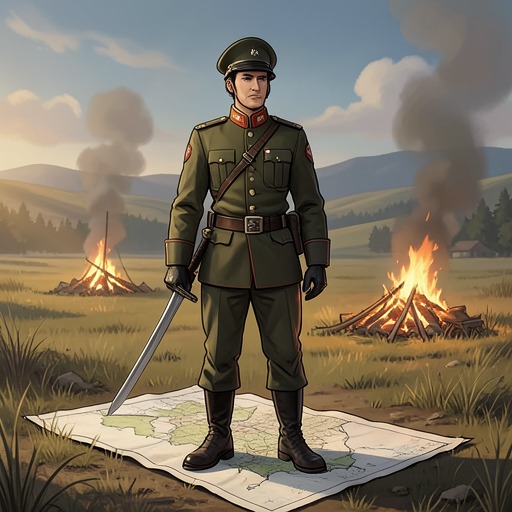
The map’s surrounding terrain was essential. It allowed Toby to locate the traverse where the stone had struck him and to imagine placing a pin on the very spot where he had stood. In this way, a broad military chart became a personal record of injury: its lines and angles joined the remembered attack to the precise ground of his bodily experience. The map succeeded in easing the burden of explanation, and the narrator identifies it as the beginning of the military hobby that would come to organize Toby’s life.
Narrative Form and Lasting Significance
The siege enters the narrative through recollection and explanation rather than as a continuous account of military operations. The narrator pauses the forward movement of the story to describe how Uncle Toby acquired the map that lets him point to his wound’s location. That account then opens onto the particular attack Toby witnessed, reconstructed through the defensive terminology that makes his story so difficult to tell. The sequence connects a remembered campaign, a bodily injury, and the later practice of studying siegeworks, while making the act of telling part of the event’s continuing significance.
The siege also belongs to the novel’s broader concern with the body as a site where theories of knowledge and health are tested. Elsewhere, Walter Shandy speculates about the pressures of childbirth and the damage they might do to a child’s brain; in discussing health, he treats the balance between radical heat and radical moisture as fundamental. These are Walter’s theories, not an independent medical account of the siege, but they echo the narrative’s attention to bodily vulnerability and attempts to explain it. Toby’s experience is rendered through specific bones, a surgeon’s assessment of the stone’s weight, and years of painful recovery; military geography, meanwhile, offers a framework through which he can revisit and organize that experience.
The lasting force of Namur in Toby’s life lies in this transformation, not in a claim that the map erases his injury. The stone’s impact removes him from service and leaves him confined; the map gives him a means to locate the scene, recount it, and turn the terrain into sustained military study. The remembered siege therefore persists as both a wound and a pattern of attention: its fortifications are at once the structures of a contested battle and the structures through which Toby makes his past intelligible.